Home/Products/PerimFence FF-200
PerimFence FF-200 · Concealed Fiber-Optic Security Fence

Architectural Metal Fencing. Invisible Optical Intrusion Detection Inside.

Secure prestigious frontages without exposing industrial sensors, overhead wires, or bulky post boxes. PerimFence FF-200 conceals 0 W pressure-sensing optical fiber and an anti-cut line inside 2 m ornamental fence modules from 0.6–3 m high, catching ≥30 kg climbs, ≥60 mm bends, and cuts instantly.
Share your fence route and target heights for a preliminary zone proposal and equipment supply quote.
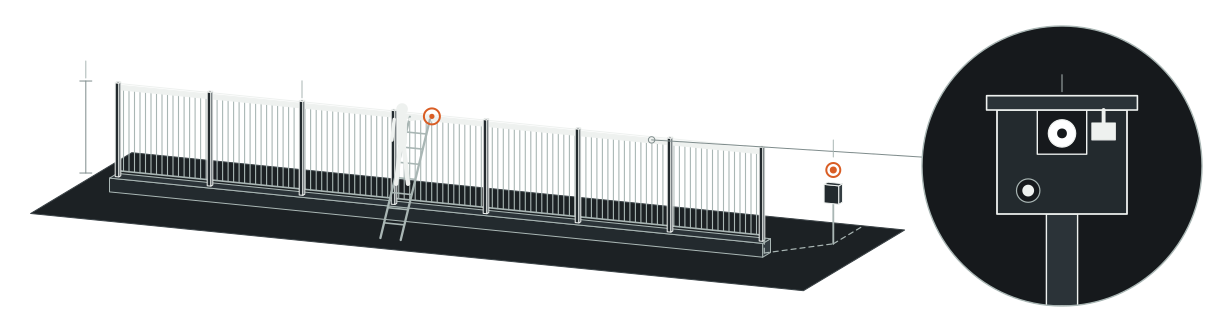
Concrete Base or Wall-Top Mounting01020304
01Architectural metal fence · 2 m module
02Tailored height · 0.6–3 m
03Upper-frame recessed slot · 0 W optical sensor
041 IP66 zone processor
Concrete base or wall-top mounting
Foothold Climb Catch
≥30 kg
Top-rail climbing pressure triggers immediate optical intrusion alarms
Anti-Pry Spread Catch
≥60 mm
Forced bar bending plus internal anti-cut and cover-tamper sensing
Architectural Modularity
2 m × 0.6–3 m
Prefabricated rail sections for concrete bases, wall tops, and slopes
Unpowered Fence Line
0 W
Zero moving parts on the rail, paired with IP66 zone processors
01 — Key capabilities

Twelve Reasons Architects and Security Directors Align on FF-200

01

Four Invisible Breach Triggers Inside the Rail

01

Concealed Top-Slot Fiber

Hide 0 W pressure-sensitive optical fiber inside the upper frame with zero visible wiring.

02

≥30 kg Climb Detection

Trigger an immediate intrusion alarm when climbing weight reaches ≥30 kg on rails.

03

≥60 mm Pry Detection

Catch crowbar spreading or forced bar bending of ≥60 mm before entry succeeds.

04

Anti-Cut and Cover Tamper

Report saw attacks via internal anti-cut lines and detect upper-cover prying instantly.

02

Architectural Fit Across Real Property Contours

05

0.6–3 m Custom Heights

Specify 0.6–3 m rail heights for low wall toppers or tall freestanding boundaries.

06

2 m Modular Assembly

Streamline civil layout and damaged-panel replacement using repeatable 2 m prefabricated modules.

07

Base or Wall-Top Mounts

Bolt cleanly onto ground-level concrete plinths or existing masonry perimeter wall copings.

08

Slope and Corner Routing

Follow undulating terrain and sharp property corners without breaking concealed optical continuity.

03

Weather-Stable Mechanics and Clean Zone Hand-Off

09

Zero Moving Sensor Parts

Eliminate mechanical wear and wind-rattle false alarms through solid-state structural sensing.

10

Thermal-Stress Adaptation

Adapt automatically to normal metal expansion and contraction stresses across seasonal swings.

11

IP66 Outdoor Processor

Operate 12–30 VDC zone processors (65 mA max) from -40°C to +70°C outdoors.

12

Dual Relay and RS-422

Deliver separate 500 mA / 50 V alarm and fault relays plus RS-422 communication.

02 — Operating principle

How Structural Force on the Railing Becomes a Verified Alarm

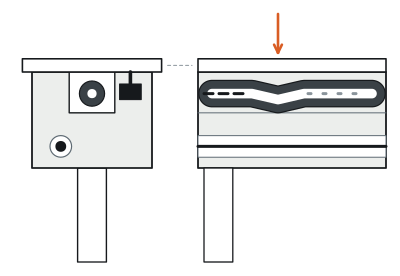
PerimFence FF-200 embeds a 0 W pressure-sensitive optical fiber assembly inside a concealed slot along the upper fence frame, turning the rigid 2 m metal modules into the mechanical collector itself.

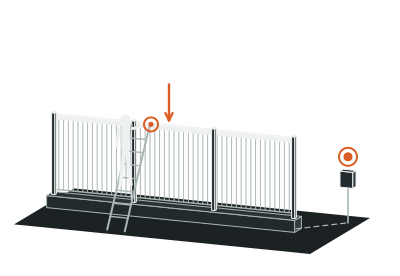
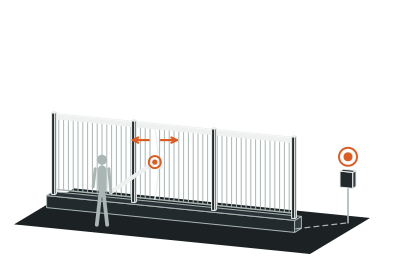
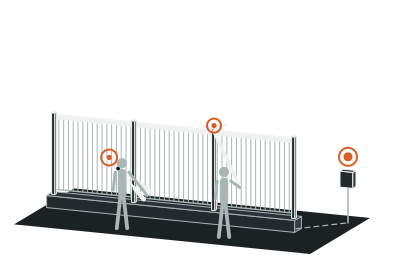
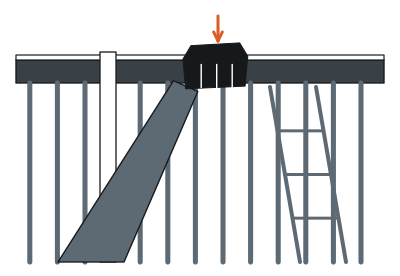
When an intruder climbs the fence with or without a ladder (applying ≥30 kg) or forces pickets apart (deforming the rail by ≥60 mm), structural strain alters light transmission inside the fiber.
Structural Breach Action
01
Structural breach action
Climb ≥30 kg · Bend ≥60 mm · Cut
0 W Concealed Optical Shift
02
0 W concealed optical shift
Upper cover / tamper
0 W · fiber + cut line
Zone Processor Output
03
Zone processor output
Isolated ports / interfaces
TVS / GDT · I/O

Cutting through the fence severs an internal anti-cut line, while prying the top slot trips an upper-cover tamper alarm.

Deploying 1 powered processor per zone, the unit analyzes the optical shift, filters normal thermal expansion stress, and closes dedicated alarm or fault contacts.

03 — Architectural look, hard-target security

Looks Like Ornamental Ironwork. Reacts to Every Real Breach Vector.

Security buyers rightly question whether an attractive architectural fence is merely decorative—wondering if an intruder can prop a ladder against the rail, jack two pickets apart, or saw through a bar undetected, or if summer sun heating steel will trigger endless false alarms.

FF-200 answers every physical attack vector directly inside the frame: climbing weight of ≥30 kg (with or without a ladder) and forced bar deformation of ≥60 mm modulate the concealed optical sensor, cutting severs the internal anti-cut line, and prying the top channel fires an upper-cover tamper alarm.
Sun, Frost, and Wind
Normal State
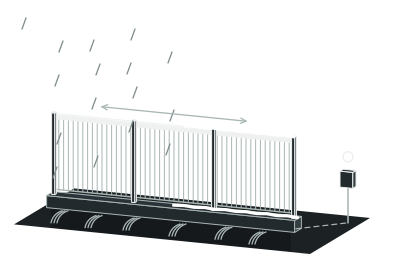
Sun, frost, and wind
Zero moving parts + thermal-stress adaptation
Baseline stable · 0 false triggers
Climbing (≥30 kg)
Vector 01
Climbing (≥30 kg)
Top-rail downward / lateral load
Immediate optical alarm
Prying / Bending (≥60 mm)
Vector 02
Prying / bending (≥60 mm)
Frame deformation alters light signal
Immediate optical alarm
Cutting or Cover Tamper
Vector 03
Cutting or cover tamper
Internal anti-cut severed / cover tamper
Immediate cut / tamper alarm

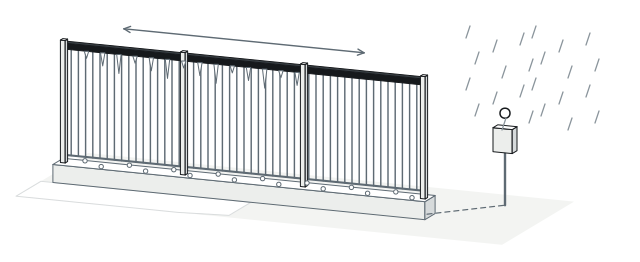
Because the 0 W rail contains zero moving parts and adapts automatically to normal thermal expansion and contraction stresses, wind, rain, hail, snow, and UV shifts pass without nuisance dispatches.

04 — Field deployment

Engineered for the boundary you operate.

Scenario 01 · Private Estates and Luxury Residences

Protect Landscaped Estate Perimeters Without Exposed Industrial Hardware

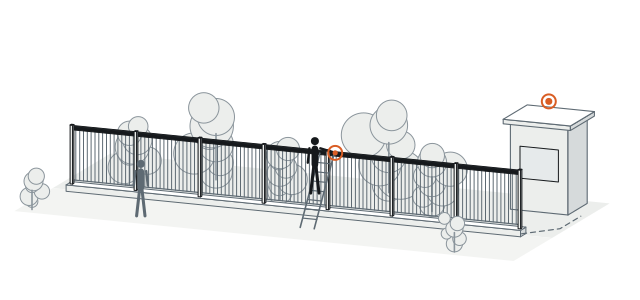
Private estate owners and landscape architects routinely veto barbed wire, taut-wire posts, and zip-tied sensor cables that ruin residential curb appeal. FF-200 delivers the clean silhouette of a fine ornamental railing in 2 m modules across 0.6–3 m heights while hiding 0 W optical sensing inside the upper rail. Any intruder applying ≥30 kg of climbing weight triggers a silent estate-security alert before clearing the boundary.

Plan this perimeter →
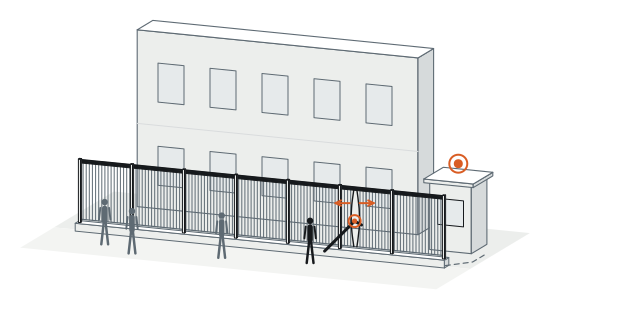
Estate boundary integration
Landscaped Street / Garden View
Landscaped street / garden view
Zero exposed cables or sensor boxes
2 m modules
0.6–3 m height
≥30 kg climb alert to guardhouse
04 — Field deployment

Engineered for the boundary you operate.

Scenario 02 · Embassies and Government Frontages

Monitor Public-Sidewalk Railings Against Crowbars, Saws, and Cover Tampering

Diplomatic compounds and ministry buildings border busy public sidewalks where infrared beams false-trigger on pedestrians and plain iron fences offer zero warning against prying tools. Because FF-200 senses structural force inside the metal barrier itself, passersby walking inches away never cause alarms—yet ≥60 mm bar bending, rail cutting, or upper-cover tampering immediately alerts the guard post.

Plan this perimeter →
Civic sidewalk boundary
Public Sidewalk Pedestrians
Public sidewalk pedestrians
Ignored
FF-200 concealed optical railing
≥60 mm bend / cut / cover tamper
Security command post
04 — Field deployment

Engineered for the boundary you operate.

Scenario 03 · Sloping Campuses and Mixed Walls

Carry One Continuous Concealed Fence Across Wall Tops, Grades, and Corners

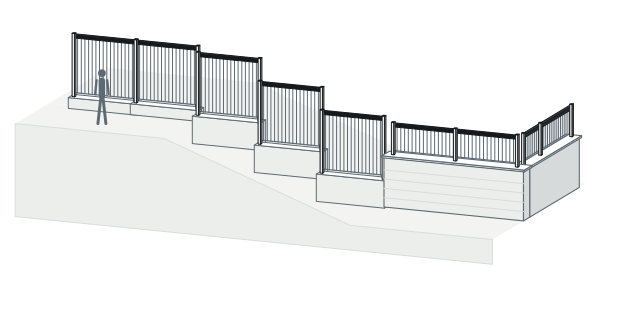
School, university, and research boundaries frequently alternate between ground-level railings, stepped masonry walls, undulating slopes, and tight corners where line-of-sight sensors leave dead pockets. Prefabricated 2 m FF-200 modules mount on concrete ground bases or existing wall tops across 0.6–3 m heights, stepping smoothly across elevation shifts and perimeter turns without breaking optical protection.

Plan this perimeter →
Mixed-elevation routing
Freestanding Concrete Base Section
Freestanding concrete base section
Sloping grade transition
Existing masonry wall-top section
2 m repeatable modules
0.6–3 m
04 — Field deployment

Engineered for the boundary you operate.

Scenario 04 · All-Weather Outdoor Stability

Prevent Metal Expansion, Wind Gusts, and Storms from Triggering Nuisance Alarms

Exposed airport landside frontages and industrial park boundaries bake in summer sun and freeze overnight, causing ordinary mechanical switches or loose fence cables to drift into false alarms. FF-200 eliminates moving sensing parts in the waterproof, corrosion-resistant rail and adapts automatically to normal thermal expansion and contraction stresses, backed by an IP66 processor rated from -40°C to +70°C.

Plan this perimeter →
All-weather resilience
Solar UV, Wind, Rain, Hail, and Snow
Solar UV, wind, rain, hail, and snow
Thermal expansion / contraction adapted
Zero moving sensing parts
0 W
IP66 zone processor
-40°C to +70°C
04 — Field deployment

Engineered for the boundary you operate.

Scenario 05 · Data Centers and Corporate Campuses

Commission Clean Perimeter Zones at 65 mA Max with Separate Alarm and Fault Relays

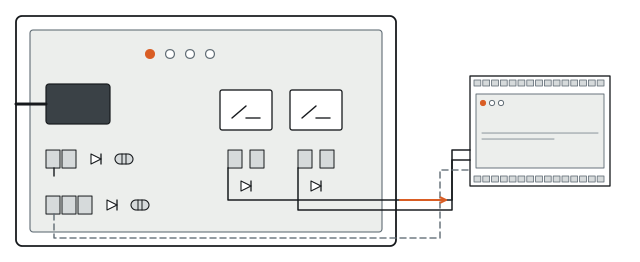
Data-center and corporate integrators want straightforward per-zone hardware that lands directly on standard alarm panels without rack-hungry optical interrogators. FF-200 deploys 1 processor per zone drawing 65 mA maximum at 12–30 VDC, outputting separate normally open alarm and fault relays (500 mA, 50 V each), RS-422 data, 4 diagnostic LEDs, and built-in TVS/GDT surge protection.

Plan this perimeter →
Per-zone IP66 processor interface
12–30 VDC Input
12–30 VDC input
65 mA max
4 status LEDs
Alarm / break / fault / TX
NO alarm + NO fault relays
500 mA, 50 V
RS-422 + TVS / GDT surge protection
05 — System architecture and bill of subsystems

How 0 W Fence Modules Connect to Per-Zone IP66 Processors

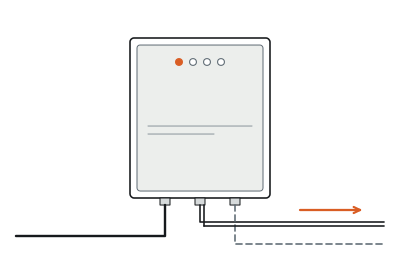
Each PerimFence FF-200 zone pairs prefabricated 0 W optical fence modules along the boundary with 1 low-power IP66 processor that hands clean relay or RS-422 signals to your security room.
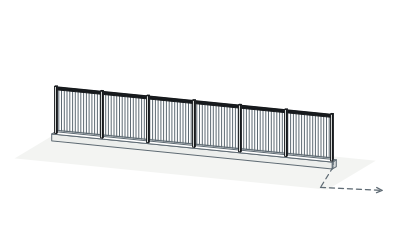
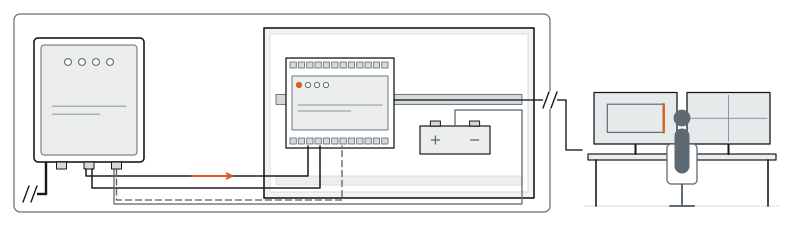
PASSIVE FIELD0 W (Unpowered)Outdoor property boundary
2 m Fence Modules in Series
01
2 m fence modules in series
0.6–3 m · 0 W
02
Concealed optical fiber + built-in anti-cut line
03
Concrete plinth or wall-top base
POWERED BACKENDPoweredProtected perimeter cabinet or nearby equipment room
1 IP66 Zone Processor
04
1 IP66 zone processor
12–30 VDC, 65 mA max
05
NO alarm + NO fault contacts
500 mA, 50 V
06
RS-422 data link
07
Security control room / VMS

System components and trade interfaces

Subsystem Layer
Components Included
Power Status
Location and Trade Scope
01 · Architectural Fence Modules
Prefabricated 2 m metal fence sections in 0.6–3 m heights for concrete ground bases or wall tops, supporting sloped and cornered routes
0 W (Unpowered)
Outdoor property boundary · Civil plinth and fence mounting
02 · Embedded Optical and Anti-Cut Core
Upper-rail recessed pressure-sensitive optical fiber assembly, internal built-in anti-cut line, and upper-cover tamper mechanism (zero moving parts)
0 W (Unpowered)
Concealed inside fence structure · Factory-integrated module interconnection
03 · Zone Detection Processor
1 IP66 outdoor processor per zone with 4 status LEDs, separate NO alarm and fault relays (500 mA, 50 V), RS-422 port, and TVS/GDT surge protection
Powered (12–30 VDC, 65 mA maximum)
Protected perimeter cabinet or nearby equipment room · SI wiring
04 · Site Alarm and VMS Integration
Receiving alarm panel, access-control I/O, or VMS platform reading dry-contact alarm/fault inputs or RS-422 zone status
Powered (Site security power / UPS)
Guardhouse or central security room · SI commissioning
06 — Technical specifications

PerimFence FF-200 Full Engineering Specifications

Detection Performance
Parameter
Standard Specification
Sensing Principle and Fence Power
Concealed upper-frame pressure-sensitive optical fiber + internal anti-cut line; 0 W unpowered fence structure with zero moving parts
Climbing-Load Trigger
≥30 kg climbing pressure on the fence (with or without a ladder)
Forced-Bending Trigger
≥60 mm structural fence deformation when bars or rails are forced
Cut and Tamper Protection
Immediate alarm upon cutting fence bars/rails (severs built-in anti-cut line) or tampering with the upper cover
Thermal and Weather Adaptation
Adaptive compensation for normal fence thermal expansion and contraction stresses; fixed sensitivity unaffected by wind, rain, hail, snow, dust, or UV
Fence Mechanics
Parameter
Standard Specification
Module Width and Height Range
2 m standard prefabricated module width; 0.6–3 m height range tailored to boundary requirements
Mounting and Terrain Fit
Freestanding on concrete bases or mounted on existing wall tops; supports sloping/undulating terrain and corners
Finish Durability
Weatherproof, waterproof, sun/UV-resistant, and corrosion-resistant ornamental fence construction
Zone Processor
Parameter
Standard Specification
Deployment Ratio and Power
1 processor per detection zone; 12–30 VDC input voltage, 65 mA maximum current
Alarm and Fault Relay Outputs
1 normally open (NO) intrusion alarm contact (500 mA, 50 V) + 1 normally open (NO) fault alarm contact (500 mA, 50 V)
Data Communication
RS-422 communication interface
Local Status Indicators (4 LEDs)
4 LEDs: optical fiber alarm trigger, fiber break, system fault, and fiber transmission status
Surge and Lightning Protection
Transient voltage suppression (TVS) diodes and gas discharge tubes (GDT) on power inputs, data inputs, and relay outputs
Environmental Ratings
Parameter
Standard Specification
Processor Enclosure and Climate
IP66 chassis protection; -40°C to +70°C operating temperature; up to 95% RH (non-condensing)

Above values reflect standard product technical specifications. Module heights, base anchor details, zone lengths, and processor locations are matched to your architectural drawings during design.

07 — Engineering FAQ

Questions Architects and Integrators Ask About FF-200

01Can FF-200 sensors be retrofitted inside an existing ornamental iron fence already installed on site?

FF-200 achieves reliable ≥30 kg climb, ≥60 mm bend, anti-cut, and upper-cover tamper performance because the optical channel and internal anti-cut line are factory-built into its prefabricated 2 m fence modules. If you must keep an existing fence untouched, consider concealed ground sensing behind the rail with PerimTerra BF-300 or PerimForce PM-280.

02Will summer sun heating dark metal rails trigger false expansion alarms?

No—FF-200 uses zero moving mechanical parts inside the fence and incorporates adaptive thermal-stress compensation that absorbs normal metal expansion and contraction across seasonal swings, while the IP66 processor operates cleanly from -40°C to +70°C.

03How do we protect pedestrian walkways, open lawns, and drainage culverts along an FF-200 frontage?

Pair FF-200 architectural rails with PerimForce PM-280 covert pressure-sensing slabs under entry walkways, PerimWave MW-400 microwave links across wide vehicle gates (5–200 m), and PerimGrille FF-250 optical grilles inside submerged culverts.

04What site details are needed to prepare an initial FF-200 layout and quotation?

Send us the total fence length, target heights per section (within 0.6–3 m), mounting base type (concrete ground plinth or existing wall top), slope/corner transitions, desired zone divisions, and nearest 12–30 VDC processor locations.

08 — Next step

Get a Preliminary FF-200 Fence Schedule and Equipment Supply Quote

Share your architectural site plan or elevation sketch. Our team will organize your boundary into 2 m modular runs, match 0.6–3 m section heights to bases and walls, and size per-zone IP66 processors.

01Perimeter route length, corner locations, and sloping or stepped sections
02Required fence heights (0.6–3 m) for freestanding concrete bases versus wall-top runs
03Preferred security zone divisions and nearest locations for 12–30 VDC IP66 processors
04Alarm hand-off preference: 500 mA / 50 V dry-contact relays or RS-422 interface
Private Estates and Embassies ↗Data Centers ↗Airports ↗Commercial Campuses ↗How PIDS Technologies Work ↗Power Planning Guide ↗Installation and Maintenance ↗Compare All Products ↗