Applications · Oil and gas
Perimeter Intrusion Detection for Oil and Gas Terminals and Tank Farms
Detection at the boundary with no power at the detector, for terminals, tank farms and the pipeline routes that serve them.
Site layout
What Goes Where on a Terminal
A terminal mixes new barrier, older mesh fence and long outer runs, with drains and a pipeline crossing the boundary.
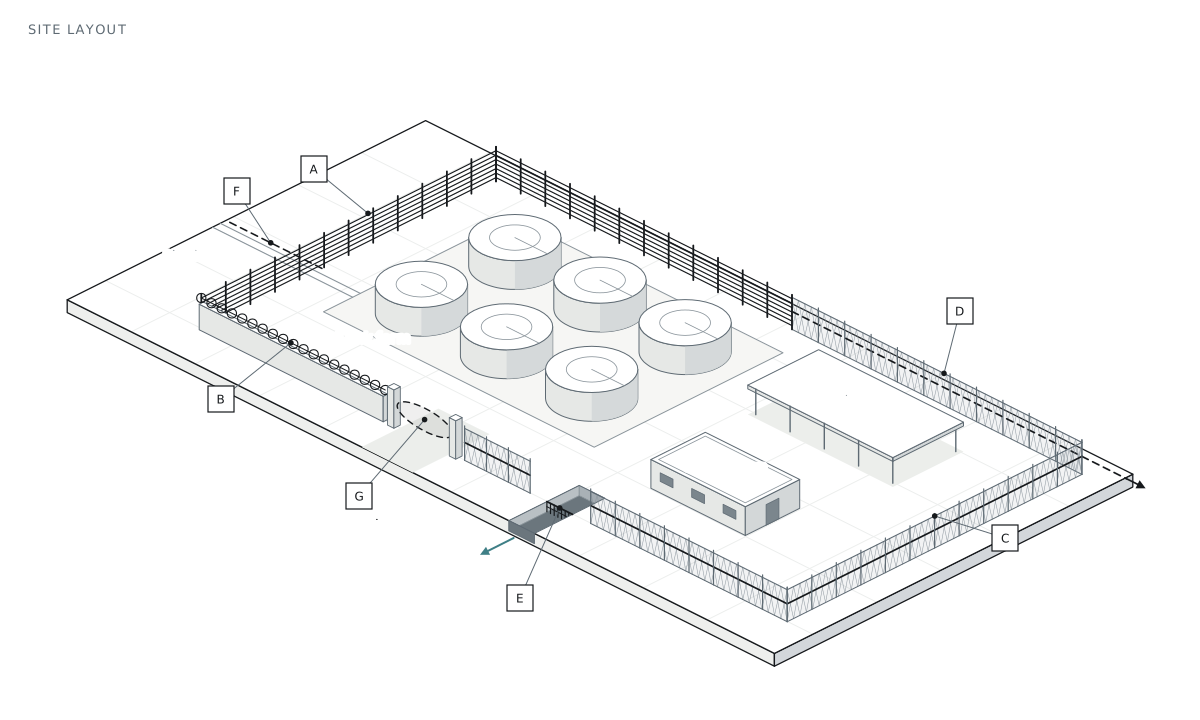
| Boundary | Product | What It Does There |
|---|---|---|
| A New barrier or wall top | PerimTaut TW-100 | A physical barrier that alarms when a wire is pulled or cut. Wire spacing is 9–20 cm. |
| B Razor-coil topping, new or renewed | PerimTaut TW-150 | A razor coil with a sensing wire inside. It alarms when the coil is pulled or cut. |
| C Existing mesh fence | PerimOptic FO-750 | Sensing fiber fixed to the fence, up to 4 zones of 300 m per processor. The processor can sit up to 20 km away. |
| D Long outer fence | PerimOptic FO-700 | Sensing fiber on the fence, up to 80 km per processor. It locates an event to about ±4 m and needs no power along the fence. |
| E Drainage culvert | PerimGrille FF-250 | A fiber-sensing grille that closes the opening. It can be used under water. |
| F Buried pipeline route | PerimOptic FO-700 | Sensing fiber buried along the route, up to 100 km per processor. |
| G Vehicle gate | PerimWave MW-400 | A microwave link across the gate lane, 5–200 m. |
Why PerimTaut
Why a Taut-Wire Barrier Suits a Terminal
The PerimTaut wires and post detectors need no power: the detector draws 0 W. Only the zone modules and controllers that report the alarm are powered.
The detector post works from -40°C to +72°C and is unaffected by EMI and RFI. The pull threshold is adjusted on site to filter out contact from animals and plants, and the barrier rarely suffers damage while its protective materials remain intact.
Read more: PerimTaut TW-100 · PerimTaut TW-150 · Power Planning Guide
Next step
What to Send Us
Send what you have. We reply with a preliminary zone proposal and equipment supply quote.
Enough to start
- Site plan
- Fence and wall types, with the length of each
- Photos of the boundary
- Culvert sizes
- Control room location