Home/Products/PerimLume LP-500
PerimLume LP-500 · Sensor-Integrated Perimeter Security Lighting

Detect the Fence Attack. Light Up the Exact Breached Section.

Put intrusion sensing, active deterrence, and camera-ready lighting inside one fence-mounted fixture. PerimLume LP-500 catches cutting, climbing, and lifting via built-in accelerometers, fires instant 53 lux LED light or strobe right at the breach, and reports over an AES-128 wireless mesh.
Send your fence layout and camera positions for a preliminary luminaire plan and equipment supply quote.
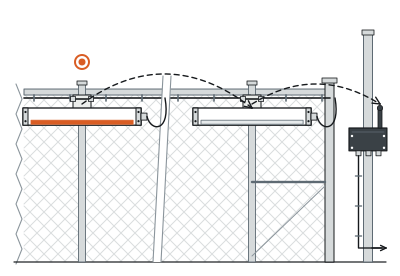
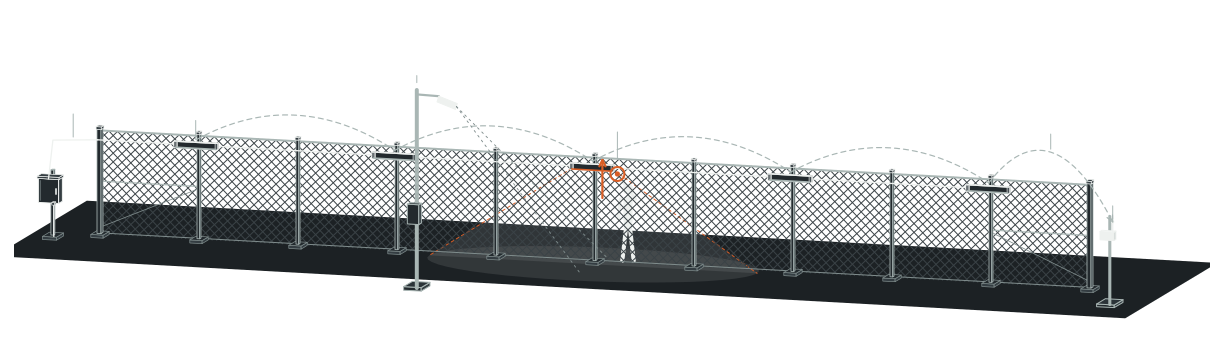
Detected fence attack010203040506
0112–48 VDC power bus (2.5 W / unit)
02LP-500 luminaires · 3–6 m spacing
03CRI >70 color view for CCTV
04Breach point → nearest luminaire instant strobe / 53 lux
052.4 GHz AES-128 self-healing wireless mesh
06IP65 gateway processor (up to 100 units)
Sensor + Camera Light
53 lux
Accelerometer fence sensing with CRI >70 LED illumination
Zero Signal Cabling
100
Luminaires per gateway on 2.4 GHz AES-128 wireless mesh
Ultra-Low Fence Power
2.5 W
Power draw per luminaire across 12–48 VDC lines
Multi-Year LED Duty
>50,000 h
Rated LED operating life from -40°C to +70°C
01 — Key capabilities

Twelve Reasons Night Perimeters Upgrade to LP-500

01

Catch and Deter at the Fence

01

Accelerometer in Every Light

Catch fence cutting, climbing, and fabric lifting directly at each fixture.

02

Nearest-Luminaire Pinpointing

Identify the exact attacked fence span by luminaire ID without guesswork.

03

Zero-Delay Instant Lighting

Flood the breach point immediately on alarm with zero lamp warm-up.

04

Programmed Strobe Deterrence

Fire high-visibility strobe flashes that expose intruders before they cross.

02

Deliver Usable Night Video

05

CRI >70 Color Rendering

Give security cameras accurate clothing and vehicle color detail at night.

06

53 lux Directed Output

Project crisp perimeter light downward instead of blinding cameras with glare.

07

120° Beam, 3–6 m Spacing

Build even fence-line illumination adaptable to any standard fence height.

08

Scheduled or Dark-Until-Alarm

Run continuous, timed, or event-triggered lighting to eliminate neighbor light spill.

03

Slash Signal Cabling Outdoors

09

AES-128 Self-Healing Mesh

Transmit alarms over 2.4 GHz encrypted wireless without fence data cabling.

10

100 Luminaires per Gateway

Consolidate up to 100 distributed fence nodes under one IP65 processor.

11

2.5 W on 12–48 VDC

Run long low-voltage power daisy-chains with minimal power-supply capacity.

12

Buffered Multi-Card Integration

Queue offline alarms locally and connect via I/O, PoE Ethernet, RS-422, or fiber.

02 — Operating principle

How One Fence Fixture Senses, Illuminates, and Reports in One Motion

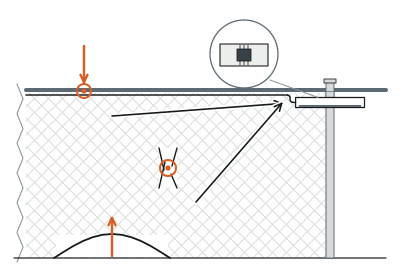
Mounted directly onto the fence fabric or posts every 3–6 m, each LP-500 luminaire houses an internal accelerometer monitoring structural vibration.
Fence Vibration Sensed
01
Fence vibration sensed
Cut / climb / lift → built-in accelerometer
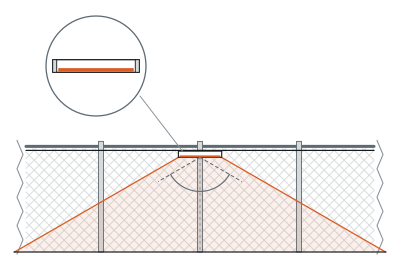
Local Light + Deterrence120°
02
Local light + deterrence
53 lux · CRI >70 · 120° instant-on or strobe
Wireless Mesh Dispatch
03
Wireless mesh dispatch
2.4 GHz AES-128 → gateway (up to 100 units)

Cutting wires, climbing meshes, or lifting the bottom rail generates distinct mechanical acceleration at the nearest fixture.

Instantly, the luminaire switches on or strobes its 53 lux, 120° LED array (CRI >70) while transmitting an AES-128 encrypted alert across the 2.4 GHz self-healing wireless mesh to the local gateway processor (up to 100 luminaires per gateway) for VMS and alarm dispatch.

03 — Closing the nighttime verification gap

Cameras Cannot Verify Pitch-Black Fence Alarms—and Floodlights Annoy Neighbors.

Most sites already own perimeter cameras, yet nighttime alarms still show grainy black-and-white shadows—while running high-mast floodlights all night wastes electricity and triggers residential glare complaints.

LP-500 solves both problems at the fence face.
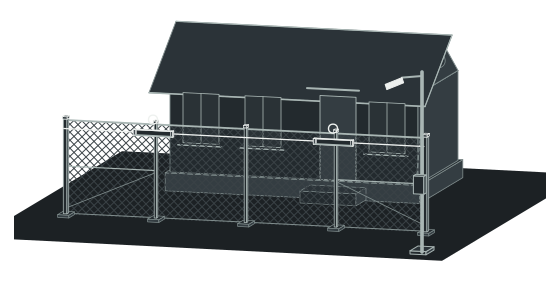
Quiet Scheduled Mode
State A
Quiet scheduled mode
Lights off · Accelerometer armed (2.5 W max)
Active Breach Response
State B
Active breach response
Nearest luminaire instant 53 lux / strobe
CRI >70 clear camera assessment

Keep luminaires off or dimmed on schedule during quiet hours; the second someone touches the fence, the nearest luminaire blasts 53 lux of directed CRI >70 light or strobe—startling the intruder and giving your existing camera crisp color evidence.

04 — Field deployment

Engineered for the boundary you operate.

Scenario 01 · Utility Substations and Critical Yards

Deter Copper Thieves Before They Cut Through—and Hand Operators Clear Video

Silent fence sensors let copper thieves finish cutting through chain-link mesh before a distant patrol car ever arrives. LP-500 turns every fence span into an active deterrent: the first cut or climb triggers immediate strobe or full 53 lux output right above the intruder’s hands, while reporting the nearest luminaire ID so substation operators pull up a well-lit camera feed immediately.

Plan this perimeter →
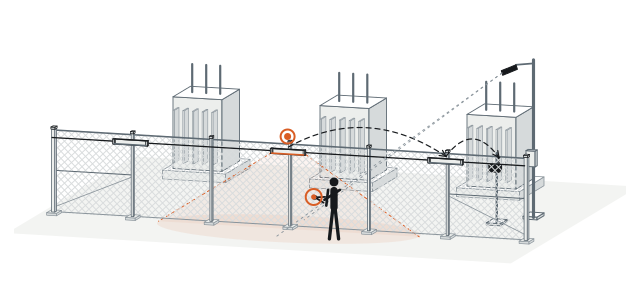
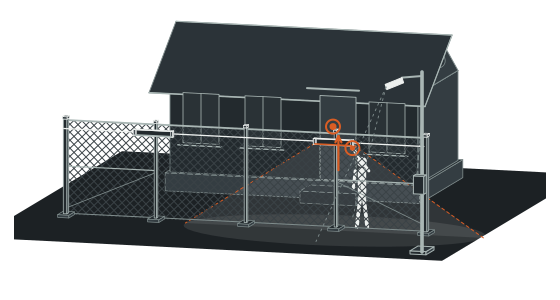
Substation fence upgrade
Fence Cut / Climb Attempt
Fence cut / climb attempt
Instant strobe deterrence
Nearest luminaire ID reported
Substation CCTV verification
04 — Field deployment

Engineered for the boundary you operate.

Scenario 02 · Residential Borders and Cultural Properties

Keep Perimeter Light Strictly on Your Fence Line—And Off Neighboring Windows

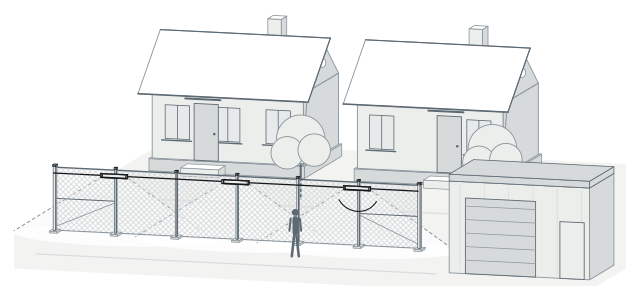
Campuses, logistics hubs, and museums bordering homes face strict municipal curfews and neighbor complaints over glaring floodlights. LP-500 mounts flush to any fence height at 3–6 m spacing, focusing a controlled 120° beam downward along the barrier. Program lights to switch off overnight and fire only when an accelerometer detects an actual breach attempt.

Plan this perimeter →
Neighbor-friendly optical control
Protected Facility Side120°
Protected facility side
LP-500 downward 120° beam
3–6 m spacing
Neighboring residential side
Programmable on/off or event-only mode
04 — Field deployment

Engineered for the boundary you operate.

Scenario 03 · Zero-Data-Cable Wireless Mesh

Connect 100 Luminaires per Gateway Over 2.4 GHz AES-128 Wireless Mesh

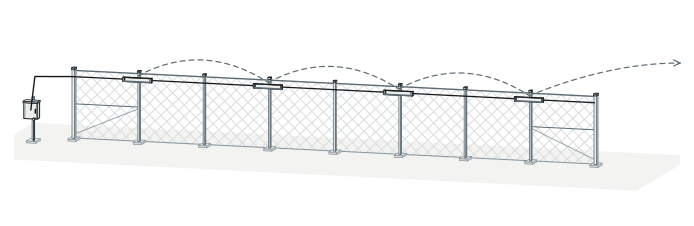
Pulling, splicing, and terminating individual copper or fiber data cables at every light pole makes retrofitting long fences labor-prohibitive. LP-500 links up to 100 luminaires per gateway over a 2.4 GHz self-healing wireless mesh secured with 128-bit AES encryption. If one wireless hop is blocked, traffic reroutes automatically—and if upstream LAN drops, the gateway queues alarms in its local buffer.

Plan this perimeter →
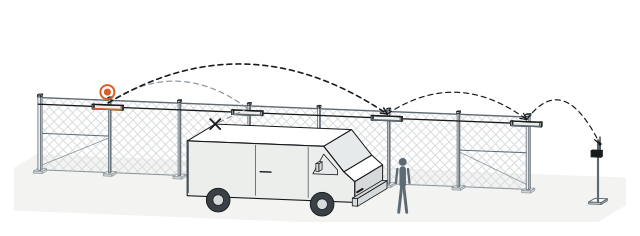
Self-healing 2.4 GHz (128-bit AES) wireless mesh
Luminaire Nodes
Luminaire nodes
01 to 100
2.4 GHz 128-bit AES wireless mesh
Automatic self-healing reroute
IP65 gateway + local alarm buffer
04 — Field deployment

Engineered for the boundary you operate.

Scenario 04 · Low-Voltage Retrofit Engineering

Mount 740 g, 2.5 W Luminaires on 12–48 VDC Lines Without High-Voltage Permits

High-voltage 220 VAC perimeter lighting demands licensed electricians, deep steel conduits, and heavy brackets that sag chain-link fabric. Weighing just 740 g (98.4 × 14.3 × 5.1 cm), each LP-500 luminaire draws only 2.5 W from a safe 12–48 VDC bus. UV-rated ASA/polycarbonate housings, aluminum-alloy brackets, and >50,000 h LEDs endure -40°C to +70°C weather.

Plan this perimeter →
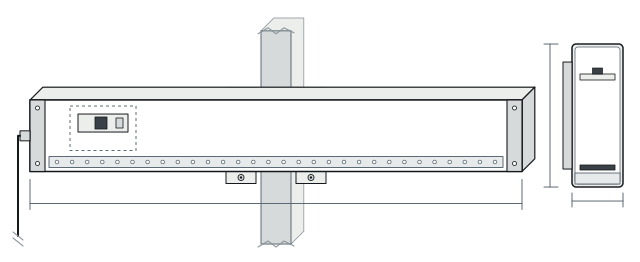
Mechanical and electrical profile of the LP-500 luminaire
98.4 × 14.3 × 5.1 cm98.4 cm14.3 × 5.1 cm · 740 g
98.4 × 14.3 × 5.1 cm
740 g
UV-rated ASA / PC + aluminum bracket
12–48 VDC
2.5 W · Surge protected
>50,000 h LED + built-in accelerometer
04 — Field deployment

Engineered for the boundary you operate.

Scenario 05 · Scalable Multi-Gateway Integration

Scale With 0.5 W IP65 Gateways Over PoE Ethernet, RS-422, or Fiber Cards

Large industrial parks and airfields need distributed fence groups that tie seamlessly into existing fiber rings, serial buses, or IP security networks. Housed in an IP65 cast-aluminum enclosure (0.5 W base; 1.0 W with comm card), the LP-500 processor provides USB setup, 10 programmable I/O ports, and optional PoE Ethernet (10/100 Mbps), RS-422 (1.2 km), multimode fiber (820 nm, 2.2 km), single-mode fiber (1,310 nm, 10 km), +4 Form C relay, and +4 input cards.

Plan this perimeter →
IP65 gateway processor interface architecture
IP65 Aluminum Gateway
IP65 aluminum gateway
0.5 W / 1.0 W
10 programmable I/O + USB port
Optional 10/100 Mbps PoE / RS-422
1.2 km
Optional MM fiber (820 nm, 2.2 km) / SM fiber (1,310 nm, 10 km)
Optional +4 Form C relays / +4 inputs
05 — System architecture and bill of subsystems

12–48 VDC Low-Voltage Power Along the Fence. Encrypted Wireless Mesh for Every Alarm.

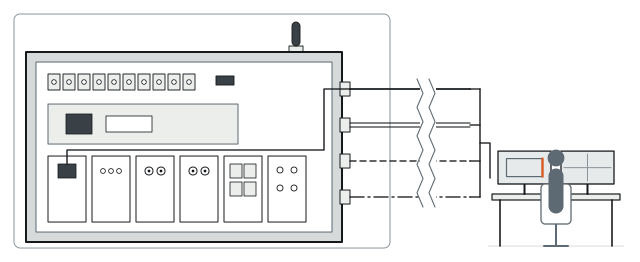
LP-500 separates simple 12–48 VDC fence power wiring from 2.4 GHz wireless alarm communication—eliminating per-fixture data cabling while keeping power reliable year-round.
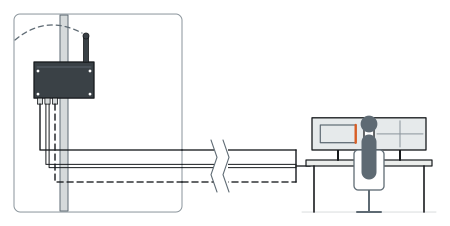
FIELD ASSEMBLYPoweredFence-mounted every 3–6 m
12–48 VDC Power Supply → Wired Fence Power Bus
01
12–48 VDC power supply → wired fence power bus
2.5 W / unit
02
LP-500 luminaires #01 to #100
3–6 m spacing
03
2.4 GHz AES-128 wireless mesh
Zero signal wires
PROCESSING / CONTROLPoweredPerimeter equipment pole/cabinet or indoor room
IP65 Gateway Processor
04
IP65 gateway processor
0.5 W / 1.0 W · Offline buffer
05
PoE Ethernet / RS-422 / fiber → control room VMS

System components and trade interfaces

Subsystem Layer
Components Included
Power Status
Location and Trade Scope
01 · LP-500 Sensor-Luminaires
Accelerometer-integrated LED luminaires (53 lux, CRI >70, 120° beam, 98.4 × 14.3 × 5.1 cm, 740 g, aluminum-alloy mounting brackets)
Powered (12–48 VDC; 2.5 W per luminaire)
Fence-mounted every 3–6 m · Fence and low-voltage crew
02 · Perimeter DC Power Bus
Low-voltage 12–48 VDC distribution cable and field power supplies protected by integrated luminaire surge circuits
Powered (12–48 VDC bus)
Along perimeter fence line · Low-voltage electrical wiring
03 · Wireless Mesh Alarm Layer
2.4 GHz self-healing wireless network with 128-bit AES encryption carrying sensor, lighting-control, and supervision packets
0 W extra cabling (RF mesh built into luminaires)
Air link across up to 100 luminaires per gateway · Zero data trenching
04 · IP65 Gateway Processor
Cast-aluminum gateway/processor (31.6 × 19.0 × 9.0 cm, 1.2 kg, 10 programmable I/O ports, USB port, offline buffer, optional PoE/RS-422/fiber/I/O cards)
Powered (12–48 VDC or PoE via Ethernet card; 0.5 W / 1.0 W)
Perimeter equipment pole/cabinet or indoor room · SI commissioning
06 — Technical specifications

PerimLume LP-500 Full Engineering Specifications

Sensing and Deterrence
Parameter
Standard Specification
Intrusion Sensing Principle
Integrated accelerometer inside every luminaire detecting fence cutting, climbing, and lifting
Event Location Reporting
Pinpoints intrusion to the nearest luminaire along the fence section
Alarm Lighting Response
Zero-delay instant-on or high-visibility strobe per programmed control
Operating Lighting Modes
Continuous on, programmable time schedule, or off until triggered by alarm
Optical and Luminaire Hardware
Parameter
Standard Specification
Illuminance and Color Rendering
53 lux per luminaire; CRI >70
Beam Pattern and Spacing
120° coverage pattern; 3–6 m typical luminaire spacing (adaptable to fence height)
LED Operating Life
>50,000 h
Luminaire Supply and Power
12–48 VDC input; 2.5 W per luminaire; integrated surge protection circuit
Luminaire Dimensions and Weight
98.4 × 14.3 × 5.1 cm; 740 g
Luminaire Materials
UV-rated ASA and polycarbonate housing with aluminum-alloy mounting bracket
Wireless Mesh Network
Parameter
Standard Specification
Frequency Band and Security
2.4 GHz wireless mesh with 128-bit AES encryption
Topology and Gateway Capacity
Self-healing mesh topology; up to 100 luminaires per gateway processor
Gateway Processor and I/O
Parameter
Standard Specification
Gateway Power Consumption
12–48 VDC input; 0.5 W base processor, 1.0 W with communications card
Gateway Enclosure and Size
IP65 cast-aluminum enclosure; 31.6 × 19.0 × 9.0 cm; 1.2 kg; transient-voltage surge protection on all I/O and power
Onboard I/O and Setup Port
10 programmable I/O ports (lighting control, supervised inputs, alarm/tamper/power-fail/fail-safe outputs); USB setup port
Network Outage Continuity
Local buffer queues alarm messages during upstream network interruption
Optional Expansion Cards
Parameter
Standard Specification
Ethernet Card
10/100 Mbps Ethernet card with PoE support (powers gateway)
Serial and Fiber Cards
RS-422 card (up to 1.2 km); multimode fiber card (ST, 820 nm, up to 2.2 km); single-mode fiber card (ST, 9/125 μm, 1,310 nm, up to 10 km)
Relay and Input Cards
4 Form C relay card (1.0 A at 30 VDC); 4 universal supervised input card
Environmental Ratings
Operating Temperature
-40°C to +70°C (both luminaire and gateway processor)
Luminaire Relative Humidity
Up to 100% RH (non-condensing)
Gateway Processor Humidity
Up to 100% RH (condensing)

Above values reflect standard product technical specifications. Luminaire spacing, 12–48 VDC voltage-drop calculations, and gateway placement are tailored to your fence height and camera layout during project design.

07 — Engineering FAQ

Common Questions Before Specifying LP-500

01Does wireless mesh communication mean LP-500 luminaires run without any wiring at all?

LP-500 eliminates per-luminaire data and alarm cables via its 2.4 GHz AES-128 wireless mesh, while each luminaire connects to a low-voltage 12–48 VDC power bus (drawing just 2.5 W per unit) to guarantee dependable year-round LED output without battery depletion.

02How precisely does LP-500 locate an intrusion compared with VC-600 or FO-700?

LP-500 reports alarms to the nearest luminaire spaced every 3–6 m along the fence while simultaneously illuminating that exact section at 53 lux (CRI >70). If your project does not need perimeter lighting and instead requires cable-only locating over 80/100 km, evaluate PerimOptic FO-700 (±4 m) or PerimVibe VC-600 (within 3 m over 600 m).

03Can LP-500 stay dark overnight near residential streets and only light up during an attack?

Yes—LP-500 luminaires can run continuously, follow a programmed nightly schedule, or remain completely off while their accelerometers stay armed, firing instant full illumination or strobe strictly at the breached section when triggered.

04How many luminaires can one gateway manage, and what happens if the site LAN goes down?

One IP65 gateway processor manages up to 100 luminaires; multi-kilometer fences simply group additional gateways over PoE Ethernet, RS-422 (1.2 km), or fiber (up to 10 km). If upstream LAN connectivity drops, local alarm messages queue in the gateway buffer while local fence strobe response and onboard I/O continue operating.

08 — Next step

Get a Preliminary LP-500 Luminaire Layout and Equipment Supply Quote

Send your fence perimeter length, fence type, and existing camera layout. Our engineers will calculate luminaire spacing (3–6 m), 12–48 VDC power drops, and 100-unit gateway groupings, and prepare an equipment supply quotation.

01Total fence length, height, and mesh/palisade construction
02Desired luminaire spacing (3–6 m) and lighting mode (continuous, scheduled, or alarm-triggered)
03Available 12–48 VDC power points along the perimeter
04Preferred gateway uplink (onboard I/O, PoE Ethernet, RS-422, or multimode/single-mode fiber)
Substations ↗Commercial and Logistics ↗Data Centers ↗Airports ↗Private Estates ↗How It Works ↗Power Planning Guide ↗Installation and Maintenance ↗Compare All Products ↗